Monday, March 13, 2023

Aerification Alert

pulling cores on No. 1 green

It's that time of year again. Greens aerification will begin this week. We will be closing the practice greens for a few hours midday Friday. Sunday tee times will end at 3:00 p.m. giving us time in the afternoon to start the aerification process. The course will also be closed all day Monday(3/20) when the majority of the work will be completed. 

deep tine aerator 

We will also be punching holes in the fairways Monday(3/20). These deep tines can penetrate 8-10" into the soil profile. This process greatly reduces compaction and allows gas exchange deep in the root zone. With proper moisture and nutrient management, roots will have the ability dive deeper into the soil allowing for a healthier stand of turf above the surface.   
  

Friday, September 30, 2022

Bunker restoration

The complete overhaul of our bunkers was completed in 2018 and not much work outside of raking and trimming around the edges has had to be put into them until this year. The crew focused a lot of effort into the bunkers this summer. Over time grass and weeds will encroach into the bunkers. The Bermuda grass in the rough will quickly send runners into the bunker and root itself in the sand. Over enough time these runners will form a full stand of grass in what used to be the bunkers edge. We spent the better part of this summer digging the grass all the way back to the bunker liner and reestablishing the original edge to all the bunkers on the property.

No. 1 bunker after                No. 1 bunker before
We have also been adding sand to areas of our bunkers that have gotten low do to play and/or wind. This fall we are looking to add sand to all bunkers, getting them back to the level they were when the bunker project was completed in 2018. 

No. 17 bunker after                  No. 17 bunker before

Hopefully all this work is admired from a distance as no golfer actually wants to be in the bunkers. After all, the bunkers are a hazard. In the unfortunate circumstance that you do have to go into a bunker please help us out, as well as the golfer behind you, by raking out your tracks.

No. 15 bunker before                      No.15 bunker during

No. 15 bunker after


Friday, July 1, 2022

The Art of Watering Greens


Water requirements for turf remain the same throughout the growing season but our irrigation/moisture maintenance practices change throughout any given time of year. Our bent grass fairways and greens require around 1.5" to 2" of water a week in the form of rainfall or irrigation. During the cooler spring and fall seasons our goal is to water deep and infrequently. We will let the surface dry out for a few days and allow the roots to dive deeper in the soil in search of moisture before a rain event or irrigation cycle.  During the summer, however, the cool season grass is more susceptible to heat stress and leaf wilt. We still try to water infrequently, but letting the soil profile completely dry out will lead to turf loss. During these hot stretches of 90+ degree days moisture levels in the greens are closely monitored. Between irrigation cycles, which is typically every 4 days, we will hand water areas of greens that are drying out faster than the rest. We can water these spots heavily in the A.M. and in certain conditions will be out in the afternoon to hand water again. During high temperature/high humidity afternoons too much, or standing water, can actually roast the crown of the plant and kill it off. A light watering, also known as syringing, is often applied in the afternoon sometimes just to lower the surface temperature, even if only a few degrees. Moisture levels are closely monitored by several members of the crew throughout the day to avoid under or overwatering. 


We know this can be a minor inconvenience to some and we do appreciate our golfers patience as we perform our afternoon watering.     

Sunday, May 1, 2022

What is Poa?

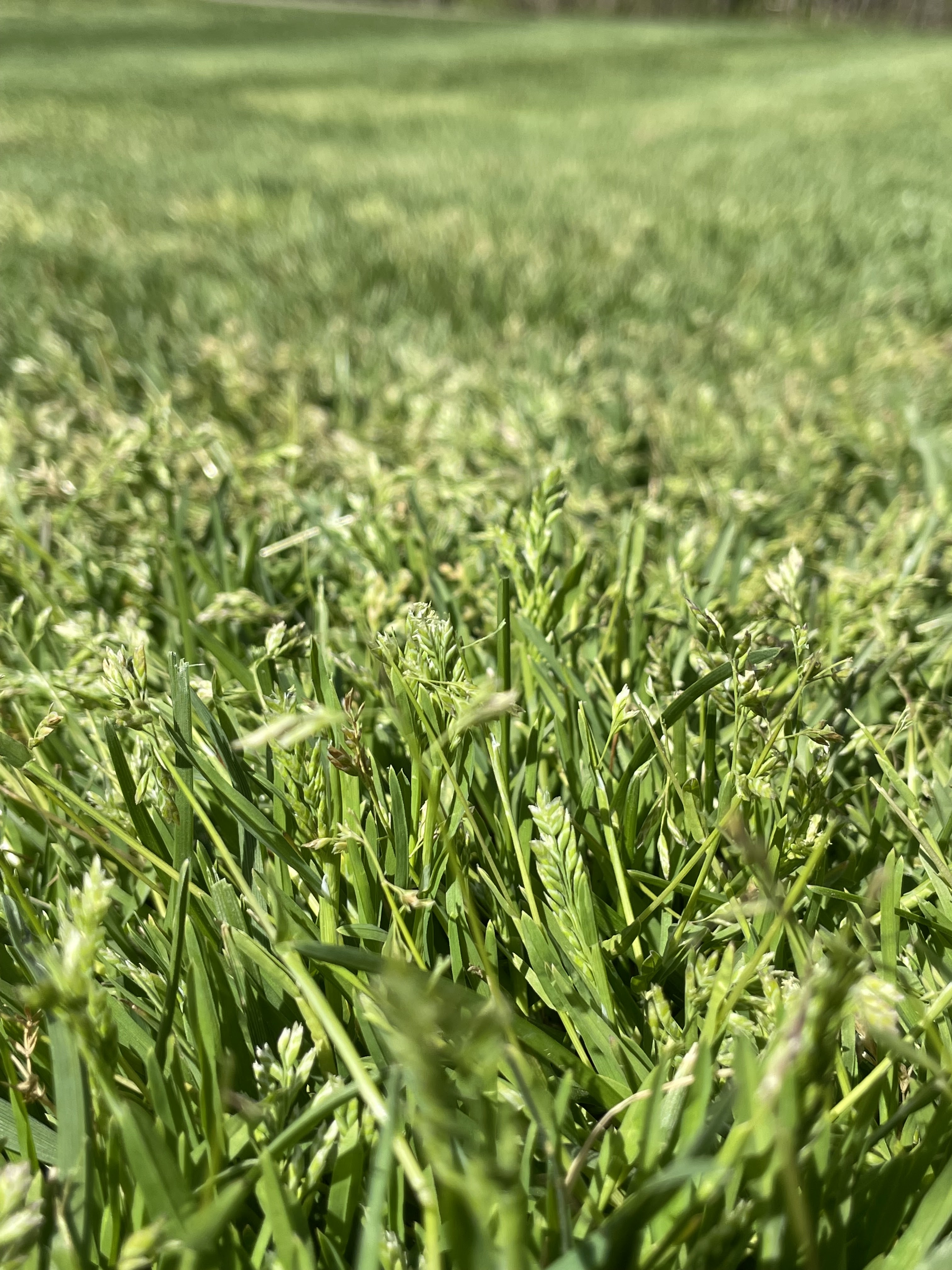
Annual bluegrass, also known as poa annua, is a turf type most commonly considered a weed or at least a nuisance. It is a winter annual which means it germinates in the late summer/early fall and matures throughout the winter. During the spring it will set seed and then eventually die off during the summer heat... Theoretically... 
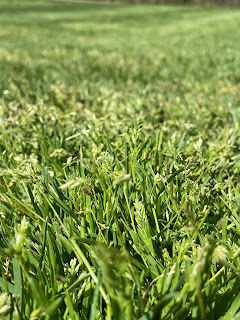
Poa at rough height


One of the problems with poa is that many types have been able to survive through the summer and act as a perennial. Poa has adapted very well to low mowing heights. It is able to produce seed at this close mowing height, giving it an advantage over more desirable turf that surrounds it. Their seed is easily spread throughout the course often from clinging onto golf shoe spikes and then being transplanted in a different location. This process repeats over and over. It can even be carried from course to course in this same manner. Once a single plant has taken root it can easily form a colony and overtake a putting surface. 
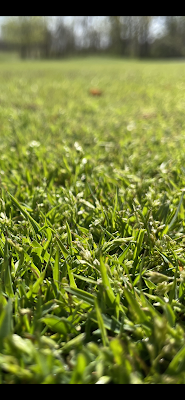
Poa at fairway height

Poa annua is undesirable because of it tendency to die off in hot weather, its off light green coloring and its seed heads. The main problem lies in the pesky seed heads that grow in early spring. At the close mowing height of a putting green the puffy seed heads are aesthetically unpleasing and affect the smoothness of the ball roll. 

At Adams Pointe our plan of action for combating the spread of poa is to use plant growth regulators(pgr). If the application timing is just right you can catch the poa just before it goes to produce its seed heads. The goal of the prg application is to stop the seeds from being produced or render the seeds it produces less viable. Certain plant growth regulators can also hinder the growth of the poa annua and not the bentgrass. This would give the desired bentgrass a chance to infiltrate some of the space occupied by the poa. 
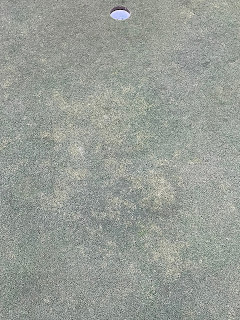

Poa at greens height

In this picture is a patch of poa in our chipping green after the plant growth regulator application. The seed heads are not obvious in the photo. You can, however, see the off color which is highlighted more so by the pgr doing its job. 

All of this is not to be a deterrence. I just played the course the other day(once a week actually) and the greens are currently rolling great! 


Wednesday, March 30, 2022

Spring into golf season

#18 topdressed before holes being punched

 As of this week winter is still dragging on a bit with over night temps still below freezing. We are still dealing with frost delays and late starts. But it is officially spring and this years golf season has unofficially kicked off. Our cool season grasses are greening up, slowly but surely, here at the Pointe. Greens aerification on March 21st went relatively smoothly but the cooler temperatures are forcing the healing process to take a little longer this spring. The greens will be turning 25 years old this year! With the greens getting up there in age and usage we have decided to implement a deep tine process every 2 years or so. The half inch in diameter tines can penetrate 4-5 inches deeper into the soil profile than our standard core pulling aerification process. Ideally, this extra depth will help drive our grass roots deeper into the soil and provide a healthy putting surface above.

Bridge on #3

Between snow storms this winter the crew was able to get a few projects completed. As always over grown brush around the course and in the native areas was cut back. Some trees have been either removed or trimmed up due to damage and/or disease. Other trees have become overgrown and impede play of the course. Most notably, a large cottonwood in front and to the right of the white tee boxes on #3 was removed. This tree was large enough for us to cut down and turn into boards for future use on the bridge that it sat next to. The major project of the winter was of course the aforementioned bridge. The bridge on #3 was in rough shape. 27 boards had to be replaced.         

A new set of tees will be opened for play April 1st. A 500 sq. ft. tee has been built roughly 70 yards closer to the fairway on the par 5 10th. The green blocks will be moved from their previous location to this new tee box.   


Tuesday, November 30, 2021

Fall 2021

The arrival of fall is always a celebrated time for the maintenance staff. The sometimes brutal heat of a Missouri summer has been survived and another successful growing season is in the books for Adams Pointe Golf Club. 

Fall is a critical time for the golf course. The health of the turf going into winter has a direct correlation to the success during next years spring and so on.  As always fall aerification has been preformed to relieve compaction and help with gas exchange in the root zone. Fairways and rough have been overseeded and are already growing in nicely. The entire course has been fertilized. Giving the grass a boost of nutrients in the fall helps the plant store all the carbohydrates needed to survive winter dormancy.     


No. 18 fall of 2021
                                                                            
Red maple trees(full fall color)


Morning mowing gets quite dark before daylight savings


Two pin oaks have been transplanted in the native area along the right side of No. 18. These trees are in the same location as the two previous trees that unfortunately had to be removed over the last couple years. Staff has always felt that the location of these trees is an important visual in framing out the courses closing hole. 
 

Pin oaks are a relatively fast growing tree that can reach 60-70 feet and will grow 24 inches or more per year. This one is currently around 12 feet or so.

Thursday, September 30, 2021

The many grasses of adams pointe


Although we saw 90 degree days late into September, fall is officially here. The sun is at a lower angle, days are getting shorter and overnight temperatures are starting to get cooler. This is all great news for our cool season turf types as they can begin to heal from the summer heat and prepare for winter. Adams Pointe, like many courses, has multiple species of grasses used for it's playing surfaces. The greens and fairways are both cool season bentgrass. The greens are a blend of Cato and Crenshaw bent cultivars while the fairways are composed of Princeville bentgrass. The roughs are mostly a mixture of tall and fine fescues and bluegrass cultivars. The tee box surfaces are a warm season zoysia grass. Mixed into almost all of the course, minus the greens, is a pesky warm season bermudagrass. The course was originally constructed with the bermudagrass and redone in 2004 with the aforementioned turf cultivars.     

As a general rule cool season grasses do most of their growing when daytime air temperatures are between 60-75 degrees. Many factors including disease, too much water and heat stress can kill off turf during the summer months. Every year in the early fall both the rough and fairways are overseeded. Along with areas that have died off or thinned out we also overseed into the bermudagrass that has invaded the fairways. Throughout the year it is a battle for ground, so to speak, between the cool season and warm season grasses. During the spring and the fall the bentgrass has the upper hand and a chance to fill in thinning areas. The opposite is true for the summer and the warm season turf types. Bermudagrass is, unfortunately for us, a very aggressive and quick spreading grass. Overseeding in the fall with bentgrass into the bermuda will introduce new plants and hopefully give the cool season grass a better chance in the fight.    

Overseeding into bermuda in fairway

Overseeding thinning/bare spots in fairway

Overseeding in the rough


Saturday, July 31, 2021

Turf Disease 101

Turf disease such as pythium, anthracnose and dollar spot affect highly managed turf during the hot and humid summer months. This July has been no exception as the humidity has been very high all month. Dollar spot is the most prevalent disease on our cool season grasses here at the course. The pathogen that causes this disease can grow when temperatures are between 50-90 degrees but is most probable when temperatures are between 70-80 degrees. Dollar spot, as well as most turf diseases, thrive in wet conditions. Prolonged leaf wetness, most commonly from mornings with heavy dew, cause the disease to develop and spread through the turf.  
Dollar spot (Clarireedia jacksonii)

Dollar spot with visible mycelium
On closely mowed turf, dollar spot injury is generally 1-3 inches in diameter and are often sunken. On higher mowed turf, they may be as much as 6 inches. Where disease is bad these spots can merge into large areas like in the top picture on this post. In the second picture the growth of fungal mycelium is visible.
Close up of mycelium on leaf blade
This mycelium can be transferred from one plant to another from mowing and foot traffic. Left untreated it has the potential to take over and kill a lot of turf but fortunately it is a relatively slow grower and can be both prevented and/or treated reactively after development. The best way to combat turf diseases is having a healthy stand of grass. Low nitrogen fertilizers with micro-nutrients are spoon fed to the greens throughout the stressful summer months. This July we applied two applications of preventative fungicides to the greens that cover a broad spectrum of turf diseases which include dollar spot.


Wednesday, June 30, 2021

Practice Facility Upgrades

Man, June was a hot one. Halfway through the month it seemed like summer had arrived early and was settling in. We had 12 days in a row of 90 plus degrees and the greens were starting to get heat stressed. We couldn't give them enough water! Fortunately, cooler days came and we were able to needle tine them just in time for the 6+ inches of rain we've seen here at the end of the month.   

Punching holes in #4 green

The practice facilities have seen a sizable increase in usage over the last year or so. The added traffic over the winter has unfortunately caused some damage to the zoysia grass on the driving range tee.  We decided to replace the first 5 feet in front of the artificial mats with fescue sod.    


Range tee before and after

We are currently in the process of adding targets to the driving range. The yardage poles will soon be sodded around with zoysia grass. The sodded areas are shaped to mimic a putting green surface. We are also building a new tee box 40 yards closer to the fairway on No.10. The green tee blocks are going to be relocated to this new tee. We are hoping to have it open for play next season.

Yardage poles on range before and after
with sod stripped but not yet sodded


Friday, April 30, 2021

MAY WE GET SOME ROLL

5 weeks after greens aerification 4/28/2021

The up and down temperatures this spring have been less than ideal growing conditions. We are 5 weeks out from greens aerification and our punch holes are still not completely filled in. That being said the greens are firm, faster than normal and rolling great! There are many factors that affect the speed of putting greens. 

Conditions that we control that affect greens speed:
  • Mowing height 
  • Mowing frequency 
  • Rolling
  • Topdressing
  • Moisture levels (to some extent)
Conditions that we can not control that affect greens speed:
  • Excessive moisture(due to rain)
  • Humidity
  • Wind
  • Turf growth rate(which can differ from day to day and season to season)
  • Time of day/sun angle and whether you are putting with or against the grain
  • Foot traffic 
  • Ball marks
  • Displaced bunker sand
Obviously, mowing height of the turf plays a roll in how fast or slow the putting surface rolls but that is far from the only factor that affects greens speed. The firmness of the green is a major component affecting the speed of a putt. It is also the larger of the challenges we face as we keep the greens both playable and healthy. Our cultural practices stay fairly consistent throughout the golf season as we mow every morning and roll several times a week. The real battle is in keeping the greens growing healthily with a combination of fertilization and irrigation without too much or too little of either. The USGA has a great article on this topic, which I encourage you to read here.

Wednesday, March 31, 2021

Parks Maintenance Sales Tax Initiative Renewal

Isn't this great? Blue skies, fresh cut grass, birds chirping. I love this golf stuff.

No.18 3/31/2021

The turf is greening up and it is beginning to look like golfing season. As always we are excited to provide our golfers with quality playing conditions all year long. Our greens are still in the healing process from our spring aerification which we completed on March 22nd this year. 

In 2017 Blue Springs voters passed a sales tax initiative that raised the sales tax one-half percent for five years, which equates to 25 cents for every $50 spent inside the city. A portion of these tax dollars were allocated for use by the golf course. The new roofing on the clubhouse, cart path and bunkers were made possible as a result of the residents of Blue Springs passing the tax initiative. Tuesday, April 6th, there is vote to renew this tax plan. Adams Pointe has already and will continue to benefit tremendously if it passes again. The other portion of these tax dollars, listed in the pamphlet below, go towards parks, trails and other public use facilities around the city of Blue Springs.  


Friday, February 26, 2021

Drainage Issues

The course is finally thawing out from the roughly 6 inches of snow we saw in the month of February. The snow would start to melt during the day and then refreeze overnight making it easy to see some of our drainage issues that we have around the course. The design of Adams Pointe is such that a large amount of water runs into drain boxes located in the fairway. No drainage system is perfect and over time new low areas show up holding water that never makes it to a drain box. Our wonderful compacted clay based soil also has trouble moving heavy rains down through its profile. Over the years the maintenance staff has added drainage pipes into some of these low, trouble spots that hold water. We have recently dug into some of these spots to find that our drain lines have been damaged. Some have been crushed and some have been accidentally punctured during aerification. Hundreds of feet of trenches have been cleaned out and new perforated drain pipe has been installed on holes #9 and #14. 

broken drain pipe #14

broken drain pipe #9

broken drain pipe #9

 
new pipe in cleaned out trench

*Adams Pointe will be closed Monday, March 22nd for spring aerification*

Sunday, January 31, 2021

Where's the Groundhog?

Maintenance work on a golf course can often be very repetitive. This is especially true for the winter months. December, January and February consist of a lot of the same work from year to year. When the weather allows us to get outside we trim/cut down trees and brush, work on drainage and irrigation issues and other projects that get pushed to the side during the busy growing season. When the weather isn't so pleasant outside we'll work on things around the shop. Painting ball washers and traffic signs, cleaning trashcans and tidying things up as we wait for spring to arrive. 

The purpose of this blog is to keep all of you updated on what is going on around the course. To keep it from also being repetitive we like to focus on projects that aren't so repetitive, boring if you will. This last month at Adams Pointe was fairly cold and quite wet. Snow/rain events were spaced out just enough so that the course was closed due to it being too wet or completely coved in snow for a majority of the month. The weather was also not conducive for us to accomplish any noteworthy projects. 

Speaking of repetitive, how about those CHIEFS? A close friend of mine writes a blog on Fansided. If you are a chiefs fan and interested in a good read, please check it out here

Wednesday, December 30, 2020

Closing Out 2020

Golf in December? Sure, why not. This December We had 13 days over 50 degrees and a few even made it into the 60's. The nice weather gave the maintenance crew a chance to knock out a few of our bigger tree projects. A maple tree by the sidewalk, coming from the clubhouse leading up to the Marriott hotel and our driving range, had some dead and decaying limbs that were becoming a safety hazard. We want to try to preserve this tree so these limbs have been removed and the rest of the tree has been thinned out. The large oak in the rough on the left side of #14 has been completely removed. We replaced the large oak tree with a maple tree as it is in play and we feel this tree location is important in framing out the fairway.


Tree by clubhouse before

After trimming off decaying limbs 

 
#14 tree removal 

2020 was an unusual year but for Adams Pointe, and the golf course industry as a whole, it was a good year. It was actually a well above average year as we saw over 40,000 rounds of golf played. We would like to take the time to thank all of the golf course staff, our golfers and members and anyone else who has helped make this year one to remember. Happy New Year and see you all in 2021.    

Monday, November 30, 2020

'Tis the Season(2020 Edition)

What can you say about the fall of 2020? If you are a golfer it has probably been one of the best fall seasons in quite some time. Many people think fall is the best time for golf. Tee shots roll out as the fairways harden up, the rough is easier to swing through as the grass is going dormant and no more sweating out 90 degree days. This fall mother nature has been fairly kind to us here at Adams Pointe. Temperatures have been above average for the most part. The average high for the month of October was 63 degrees, perfect golfing weather. We also had 8 days during October of 80+ degrees and 8 days in November where temperatures reached 70+ degrees and only a handful of frost delays so far. Thank you bonus golf!

As fall comes to an end the course has been over-seeded and fertilized. Fertilization in the fall is critical as the turf needs nutrients through its winter dormancy stage. Seeding during the fall is like doubling down and ensuring that when spring comes around you will be off to a good start with your cool season grasses.

Unfortunately, as December is upon us, it looks like old man winter is settling in. 

Winter time allows the maintenance crew to get some of the projects that had to be put on the back burner during the golfing season. This year a number of trees will be removed and/or trimmed back. This will be done for playability issues, safety concerns and to improve turf health in areas where trees have become overgrown. We will also be planting a few new trees around the course. Specifically #'s 18 and 14. These holes both have a couple trees that are in play and also help frame the layout of the hole. Unfortunately, these trees have become unhealthy and will need to be removed. 

Parking lot pond bank before

Pond bank after

Landscaping beds around the clubhouse and parking lot are currently in the process of a major overhaul. Weeds, mulch and old overgrown shrubs have been removed and replaced with rock. We are doing the same rock work around all of the tee signs on the course as well. We feel this style of rock landscaping will require less maintenance for us and still be aesthetically pleasing for golfers and guest visiting the clubhouse. 
Tee sign flower beds before
Weeds have been removed and a weed barrier is laid
to help prevent new weed infiltration 

Finished tee sign 


Saturday, October 31, 2020

Fall Update

Has this year been a little different? Yes it has. We have all been tested and we have all probably made some changes. Adams Pointe has made some changes as well.

New bunkers, check

New cart paths, check 

Next on the list is a project we have been working on over time for the last year. Overgrown bushes have been removed from landscaping beds around the clubhouse. Mulch is being replaced with rock in these beds. We are also incorporating rock around our tee signs on the course.